
A lot of people regret buying the Godox iT30 Pro now that the iT32 is out.
For roughly a hundred dollars, the iT32 gives you more output, a rotating head, and a magnetic system that lets you go off camera in seconds with the included X5 trigger. On paper, it sounds like an obvious upgrade.
Letwell sent me the iT32 Pro for review, but I’ve been using Godox flashes for over ten years. These are my honest impressions after using it.
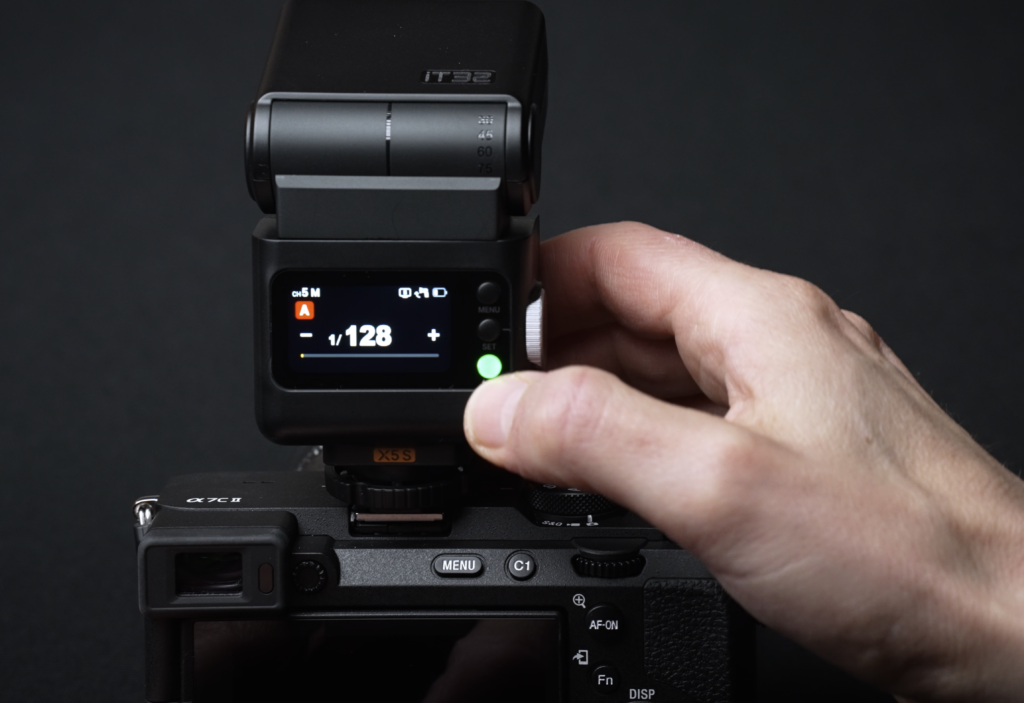
Size and General Concept
The iT32 is still very compact compared to a traditional speedlight, but it’s clearly bigger than the iT30. That extra size is not wasted.
The rotating head completely changes how usable the flash is on camera. You can bounce light off ceilings or walls without any extra accessories, which was one of the main limitations of the iT30.
I don’t like pointing a flash straight at people. The light is too hard. Simply bouncing the flash already gives much nicer results, and the iT32 finally makes that easy.
That said, expectations matter. With a guide number of 18, this flash has just enough power to work at full output in rooms with low ceilings or white walls. Once you start stopping down or working in larger spaces, you’re at its limit.
Recycle time is around a second and a half at full power, and battery life is good for roughly 500 flashes. For a flash this small, that’s genuinely solid.
Low-Key Shooting and TTL
One of the biggest strengths of the iT32 is how discreet it is. It doesn’t scream professional photographer. Paired with a compact camera like the Sony A7C II, it blends into everyday situations easily.
This is not a flash for wedding photographers or demanding professional work. It simply doesn’t have the power most of those situations require. But for smaller gatherings, casual events, or personal projects, it works well.
TTL plays a big role here. The flash measures light through the lens, adapts as you move, and lets you fine tune exposure from minus three to plus three. Once it’s set, you stop thinking about settings and focus on shooting.
Magnetic System and Off-Camera Use
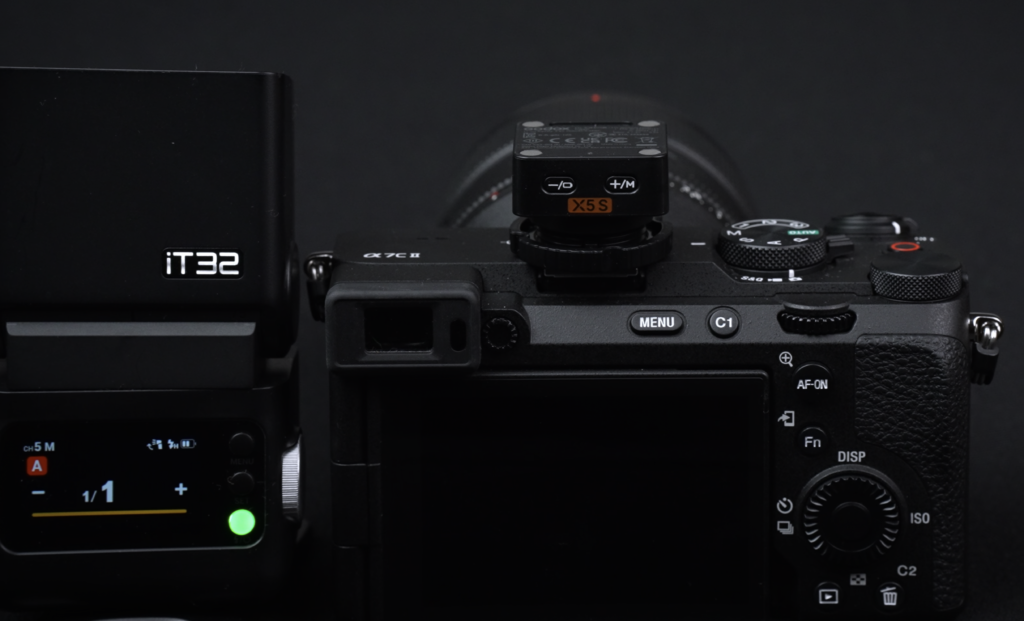
The most interesting feature is the magnetic system. The flash detaches easily from the hot shoe, which is actually the trigger itself. You can switch from on camera to off camera in seconds.
The light on its own is still harsh. The included plastic diffuser helps a bit, but it won’t save you. If you plan to use this flash off camera, adding a small softbox makes a big difference and is the sensible way to use it.
One thing worth changing right away is the trigger range. By default, it’s set from one to one hundred meters, which makes little sense when you’re working close to the flash. Setting it to zero to thirty meters is much more practical.
A simple setup works well. Place the flash in a softbox with a speedlight mount and a handle, hold the camera with one hand and the light with the other, and position it at about a 45 degree angle, slightly above eye level.
HSS and Power Limits
The iT32 supports high-speed sync, which is useful if you want to shoot wide open outdoors and go past your camera’s flash sync limit. On the Sony A7C II, that limit is 1/160.
In winter or low-light outdoor conditions, HSS works. But it’s important to remember that HSS cuts flash power even further, and this flash doesn’t have much power to begin with. It’s usable, but only within clear limits.
Trigger, Controls, and Compatibility
The X5 trigger comes bundled with the flash and is also sold separately. If you shoot with multiple camera systems, that’s a nice bonus since extra triggers are relatively inexpensive.
Godox claims the X5 can control other flashes, but control is limited. You can’t adjust power from the trigger. Other flashes will fire if they’re set to Group A, but power has to be set directly on the flash.
The iT32 itself can act as a trigger for multiple groups, but the experience isn’t great. Controls are slow, and power adjustment only goes down to one one-twenty-eighth.
If controlling multiple flashes is important to you, a dedicated trigger like the X3 or X3 Pro makes more sense. With those, you can fully control the iT32, including the modelling light, which this flash does have. You can also set that modelling light to turn off automatically when you shoot.
Accessories and Small Details
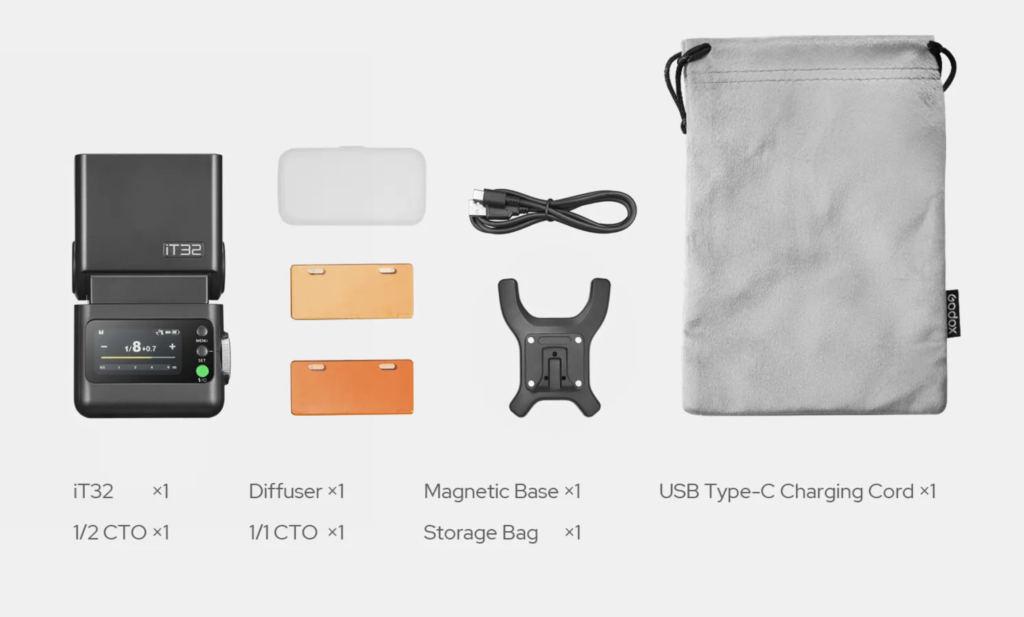
The flash includes a magnetic stand, which lets you place it anywhere as a small accent light, or mount it on a light stand with a narrow thread adapter.
Two magnetic color filters are included: half orange and full orange. These are useful for matching warm indoor lighting so the flash blends naturally into the scene. Other colors are available if needed.
The flash head also includes a wide angle diffuser and a small bounce card.
Final Thoughts
The iT30 is smaller, and for some people that alone is reason enough to prefer it. But for most users, the iT32 is a more complete and more usable flash.
It’s not very powerful, and it’s not designed for complex lighting setups or demanding professional work. That’s not what it’s trying to be.
As a first step into flash photography, the iT32 makes a lot of sense. You don’t need a separate trigger, it works straight out of the box, and it’s easy to carry everywhere.
If you already own bigger lights, there will be plenty of situations where you’ll prefer to leave them at home and bring this instead.
If you know you need more power from the start, jumping straight to something like the V480 is the better move, keeping in mind it’s larger and requires a separate trigger.
In my case, the iT32 replaces the iT30 as my casual daily carry.